Dear all,
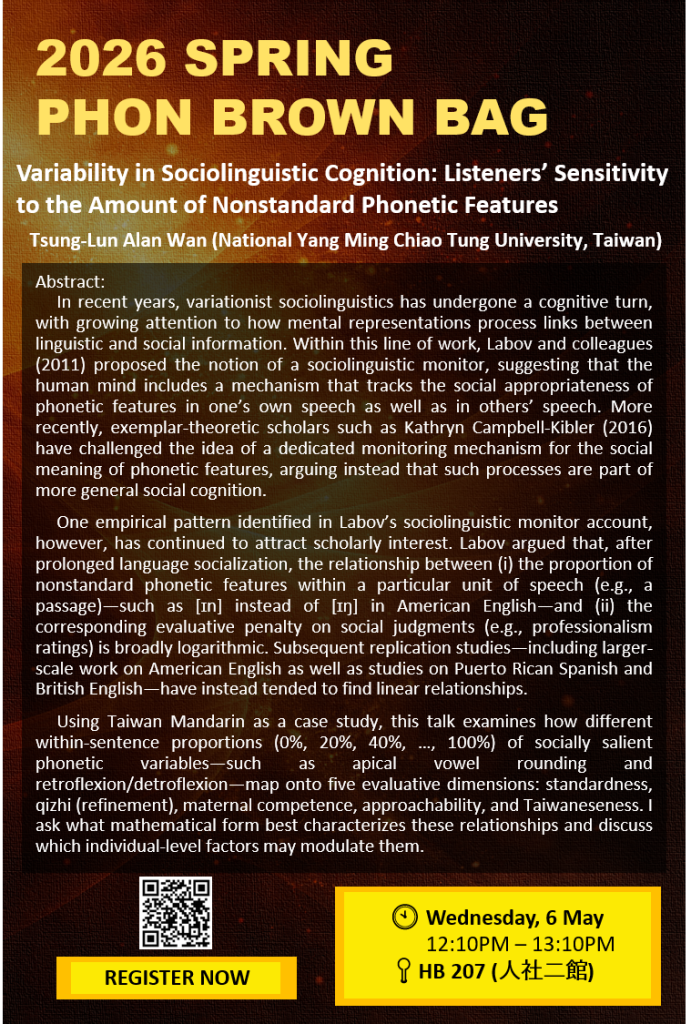
We are pleased to invite you to our upcoming Brown Bag meeting featuring Prof. Tsung-Lun Alan Wan. The details of the event are as follows:
Time: 12:10–13:10, Wednesday, May 6
Venue: HB 207 (人社二館 207), NYCU
Registration: Please register in advance via the following link:
https://forms.gle/
In recent years, variationist sociolinguistics has undergone a cognitive turn, with growing attention to how mental representations process links between linguistic and social information. Within this line of work, Labov and colleagues (2011) proposed the notion of a sociolinguistic monitor, suggesting that the human mind includes a mechanism that tracks the social appropriateness of phonetic features in one’s own speech as well as in others’ speech. More recently, exemplar-theoretic scholars such as Kathryn Campbell-Kibler (2016) have challenged the idea of a dedicated monitoring mechanism for the social meaning of phonetic features, arguing instead that such processes are part of more general social cognition.One empirical pattern identified in Labov’s sociolinguistic monitor account, however, has continued to attract scholarly interest. Labov argued that, after prolonged language socialization, the relationship between (i) the proportion of nonstandard phonetic features within a particular unit of speech (e.g., a passage)—such as [ɪn] instead of [ɪŋ] in American English—and (ii) the corresponding evaluative penalty on social judgments (e.g., professionalism ratings) is broadly logarithmic. Subsequent replication studies—including larger-scale work on American English as well as studies on Puerto Rican Spanish and British English—have instead tended to find linear relationships.
Using Taiwan Mandarin as a case study, this talk examines how different within-sentence proportions (0%, 20%, 40%, …, 100%) of socially salient phonetic variables—such as apical vowel rounding and retroflexion/detroflexion—map onto five evaluative dimensions: standardness, qizhi (refinement), maternal competence, approachability, and Taiwaneseness. I ask what mathematical form best characterizes these relationships and discuss which individual-level factors may modulate them.